
What is the common name for this type of treatment?
The common phrase for this type of treatment is something called All-on-4. The truth is, the number of implants used may not always be four. Sometimes it may be four, and sometimes it may be five, six, or even more. But the general idea of this treatment is that we're replacing all of the teeth in an arch with a new set of teeth that are fixed to dental implants, so the patient doesn't remove them when they go home at night.
How is All-on-4 different from other dental implant treatments?
All-on-4 is different from other dental implant treatments in the overall goal of the treatment. First, it should be known that All-on-4 is designed to replace all of the teeth on the upper arch, lower arch, or both.
Secondly, a full-arch prosthesis is going to be fixed to the implants so that it doesn't routinely come in and out. That's different from a single-tooth dental implant with a crown or an implant-supported option that's designed to be removable. Simply, the goal is different with an All-on-4 type of procedure.
Who is a candidate for All-on-4 dental implants?
All-on-4 dental implants can be a wonderful treatment, but only specific patients are truly candidates for it. First, it should be said that this treatment is generally considered for patients who are already missing all of their teeth in an arch or whose remaining teeth cannot be predictably maintained. All-on-4 dental implants aren't simply a cosmetic treatment.
If someone is a candidate from a dental perspective, we also want to look at the available bone because that's where the implants will go. We also look at the patient's medical history to see if there are health factors that may affect the surgery, healing, or implants.
Are seniors too old for All-on-4 treatment?
All-on-4 dental implants are a treatment option that may be considered for seniors. Many patients ask us if they're too old for these treatments. Age alone doesn't necessarily rule someone out. We need to consider the patient's overall health, quality of life, oral condition, and other factors to determine if they're a candidate.
How does bone loss affect dental implant treatment?
Many patients ask us questions about bone loss in the jaw and how that affects dental implant treatment. We need to do an evaluation to see how much bone is available and determine if the patient is a candidate. The amount and location of the available bone are important factors when we're planning where dental implants can be placed.
How is the All-on-4 dental implant process done?
The All-on-4 dental implant process can be done a few different ways. It varies from person to person. One approach people commonly hear about involves removing the remaining teeth, placing the implants, and, when the situation allows, what we call loading the prosthesis the same day.
Basically, that means the patient can leave with a temporary set of teeth that's fixed to the implants. The specific instructions for using those temporary teeth during healing depend on the individual procedure and the stability of the implants.
How long does the All-on-4 procedure take?
The All-on-4 procedure varies from patient to patient depending on the number of implants being placed, the number of teeth being removed that day, and if we're going to be loading what we call the prosthesis, which is connecting the temporary teeth to the implants.
However, it should be said that this isn't a short procedure. It's typically at least a full morning and sometimes even longer, depending on the treatment being performed.
How long do All-on-4 results last?
It should be noted that the goal of an All-on-4 procedure is to provide a long-term fixed solution in the mouth. That being said, there's always going to be ongoing maintenance with the teeth, and sometimes a new prosthesis or repairs may be needed over the years.
It's not a set-it-and-forget-it type of situation. It's more like owning a car. There's still going to be some maintenance needed afterward.
What are the advantages and disadvantages of All-on-4?
Many patients who are currently missing their teeth will tell you that they have difficulty eating, chewing, or smiling confidently. Some people may not even want to go out because they're self-conscious about their smile or about wearing removable dentures.
An All-on-4 dental implant solution is fixed in the mouth, which can provide greater stability for eating and speaking than a traditional removable denture. It can also help some patients feel more confident about their smile. Those are some of the main potential advantages over traditional removable treatments.
At the same time, All-on-4 involves surgery and requires ongoing professional and at-home maintenance, so we discuss the advantages, limitations, and responsibilities involved before moving forward with treatment.
What changes can you expect before and after All-on-4 treatment?
One of the most transformational things that we can do in improving a patient's smile is taking someone who has severely broken or nonfunctional teeth and giving them a new smile. We have a smile gallery on our website that shows before-and-after examples of the treatments we provide.
We take a lot of pride in All-on-4 dental implants and other treatments used to restore the smile. Depending on the individual patient, treatment can improve the appearance of the smile and chewing ability, and it can help patients feel more confident.
What is postoperative care like after All-on-4?
Of course, this depends on how many teeth we're removing that day, whether we're working on both the top and bottom or just one arch, and the patient's overall medical status. Generally speaking, patients can expect some soreness and swelling after the procedure. We provide instructions for managing discomfort and taking care of the surgical areas during healing.
The amount of soreness and swelling, as well as how long it lasts, varies from patient to patient. We'll monitor your healing and give you specific postoperative instructions based on the procedure you've had.
How long do All-on-4 dental implants last?
When a dental implant is placed into the jaw, the goal is for it to provide long-term support for the replacement teeth. Of course, biologically, things can happen. Anything that involves surgery and the body can't be guaranteed to last forever.
With an All-on-4 procedure, there is also a prosthesis that goes on top of the dental implants and is fixed in the mouth. Just like a set of tires that wears over time, those teeth can wear over time as well. The prosthesis may eventually need maintenance, repairs, or replacement depending on how it wears and functions.
What dental care is needed after All-on-4 treatment?
This is a great question. I think it's an important one. Many times in advertising, All-on-4 is presented as a set-it-and-forget-it kind of thing. Basically, it's done and you don't have to worry about anything ever again. Unfortunately, that's not the case when it comes to maintenance.
Just as if you owned a really nice car, it would still need tire changes, rotations, and oil changes. Likewise, you still need to come in for routine professional care so we can monitor the health of the implants and the prosthesis. Patients also need to take care of their All-on-4 restoration at home according to the instructions they're given.
At Periodontics and Implant Dentistry of Tallahassee, you come first. Whether you need dental care or simply have questions, call us at (850) 909-9731 or email [email protected] to schedule your visit. Our team is here to help you every step of the way.
Replace an Entire Row of Teeth in 1 Appointment
If you have several missing teeth or even an entire row that is gone, then your oral function is probably severely compromised, and you want to have it fixed as quickly as possible. Traditional implant procedures usually require months to be completed, but there are exceptions: All-on-4 dental implants in Tallhassee, FL. With this treatment, Dr. Rasmussen can restore an entire row of teeth in a single appointment, helping a patient reclaim their health, bite, and confidence in a matter of hours. Want to learn more about All-On-4? If so, give us a call today.
Why Choose Periodontics & Implant Dentistry of Tallahassee for All-On-4 & Teeth-in-a-Day?
- Treatment Provided by a Board-Certified Periodontist
- Helps Patients Avoid the Need for a Bone Graft
- Customer Service That Ensures You Feel Welcome & Comfortable
How Do All-On-4 Dental Implants Work?
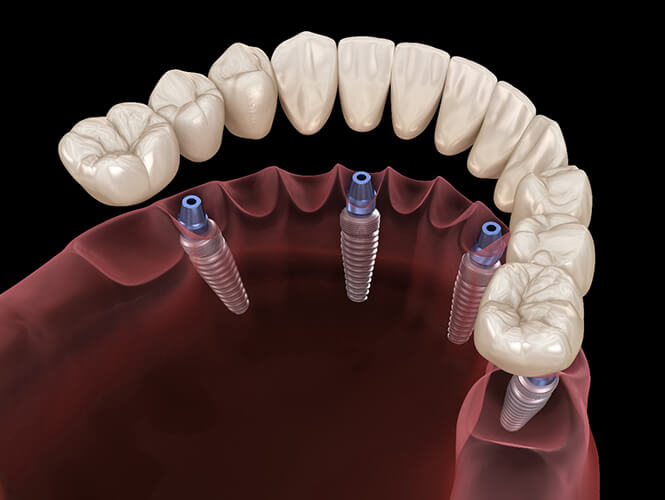
On the surface, All-On-4 implants might sound too good to be true, but Dr. Rasmussen has already used this procedure to help countless patients quickly reverse years of tooth loss. Just four special dental implants are placed along the jaw at specific locations so they can provide the most support possible for a new denture. Typically, two are located towards the front of the bone with another two towards the back that are slightly tilted. This is where the jawbone is naturally thicker, maximizing a patient’s existing bone density. Once the implants have been positioned within the bone, they are immediately attached to a full denture, instantly giving a patient the new teeth they desire.
Am I A Candidate For All-On-4 Dental Implants?
All-On-4 dental implants are usually recommended for patients who are missing most if not all of their teeth along their upper or lower arch. Most people in this situation have experienced quite a bit of bone loss as well, so much so that traditional dental implants are not a viable option. All-On-4 implants are specially designed to help patients in this situation. If you have extensive tooth loss and have been told you’re not qualified to get dental implants in the past, then this procedure was made for you.
What Are the Benefits of All-On-4 Dental Implants?
Speed: In a single appointment, a patient can completely renew their smile and vastly improve their ability to speak and eat comfortably.
Cost: In most cases, the cost of getting All-On-4 dental implants is less compared to a traditional implant denture, which often requires six to eight implants to stay in place.
No Bone Graft: As we touched on above, All-On-4 dental implants are meant to work with a patient’s existing jawbone even if it has shrunk, meaning it helps many avoid the need for a bone graft procedure. This helps lower the overall cost and shortens the time a patient needs to replace their teeth.
All-On-4 vs. Traditional Dental Implants
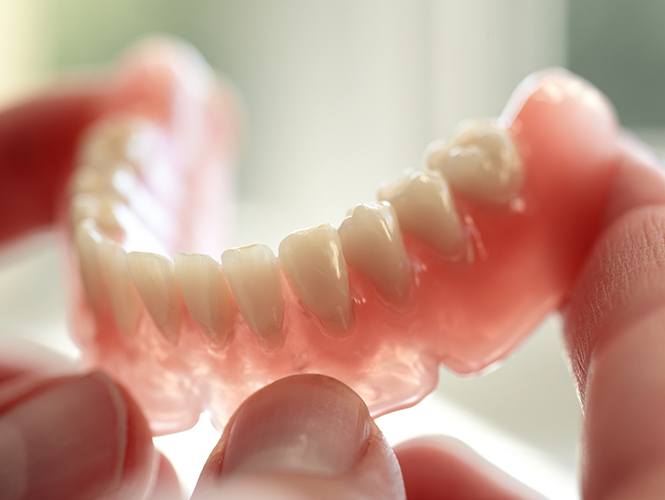
The posts used for All-On-4 tend to be bigger compared to traditional implants, and this is why such a small number of them can be used to secure a full denture. Traditional implants are usually placed in the specific locations where teeth have gone missing, but with All-On-4, they are spaced across the entire jawbone. All-On-4 implants are designed to maximize a patient’s jawbone density, which is why they are exclusively located in the thickest part of the bone.
All-on-4 FAQs
All-on-4 is a different kind of dental implant treatment, so it’s not unusual for patients to have plenty of questions about how it works. We encourage you to reach out to us right away if there’s anything you’d like to know about All-on-4 before you decide whether you want to move forward with it. To help make things a little easier, we’ve answered some of the most frequently asked All-on-4 questions below.
Will All-on-4 Look Like My Natural Teeth?
Yes, dentures supported by All-on-4 implants look and feel very natural. The implants themselves won’t be visible because they’ll be covered by your dentures and your gums. Your new teeth will be made out of materials that closely resemble natural tooth enamel. Your restoration will be customized with your unique smile in mind so that the final results are as lifelike as possible.
Additionally, since the implants will keep your teeth firmly in place, there’s no risk of your dentures slipping or moving at awkward times. This can help you feel much more confident in your smile and your overall appearance when interacting with others.
What Can I Eat After All-on-4?
With traditional implants, you would normally be limited to only eating soft and liquid foods for a while after the surgery. However, that’s not necessarily an issue with All-on-4. Because you can often receive your new teeth on the same day that All-on-4 dental implants are placed, you may be able to eat solid foods right away following the procedure. That said, you will need to avoid hard, brittle, or chewy foods for a while. It will typically take around 6 to 10 weeks for you to be able to return to a normal diet.
Is the All-on-4 Procedure Painful?
There’s little to no discomfort during the surgery itself because a local anesthetic is used to numb the mouth beforehand. Also, if any kind of sedation is used, it will further reduce your body’s ability to notice pain. And of course, our team will take whatever steps are needed during the procedure to help you stay comfortable.
Once the treatment is complete and your mouth is no longer numb, you’re likely to experience some mild soreness and swelling. It should only take a few days for these side effects to subside, but we do recommend that you call us right away if there’s any severe pain.
What is the Success Rate of the All-on-4 Procedure?
The success rate of All-on-4 is as high as 98% for both the upper and lower jaw, meaning it’s a very reliable choice for anyone that’s eligible for the procedure. Of course, even with an extremely high success rate, you still have to be aware of the possibility of dental implant failure. Make sure that you’re practicing excellent oral hygiene after receiving your new teeth; daily brushing and flossing are essential for preventing gum disease that could lead to complications with your dental implant posts.